“Violent video games” usually refers to games that depict physical fighting, weapon use, or other forms of harm (often reflected in age/content rating systems like ESRB and PEGI).
Below are recent, data-backed statistics on how common violent content is in what teens play, how games are rated for mature content, and how the public views the violence debate.
violent video games statistics
Key violent video games statistics
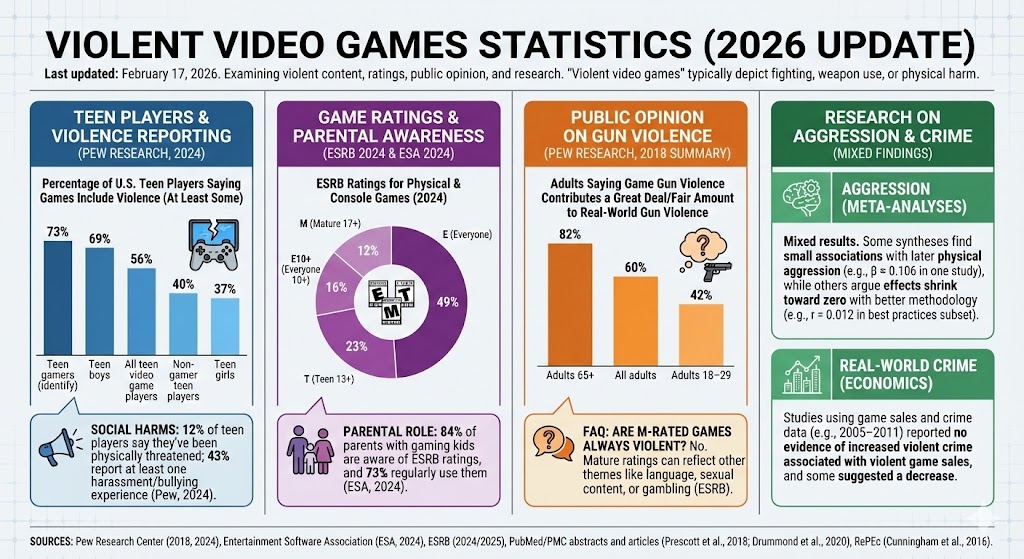
56% of U.S. teen video game players say at least some of the games they play contain violence; 16% say violence is in all or most of the games they play. Source: Pew Research Center (May 9, 2024), https://www.pewresearch.org/internet/2024/05/09/teens-and-video-games-today/
Teen boys are far more likely than girls to say the games they play include violence: 69% vs. 37% (at least some). Source: Pew Research Center (May 9, 2024), https://www.pewresearch.org/internet/2024/05/09/teens-and-video-games-today/
By identity, 73% of teen “gamers” say at least some games they play contain violence vs. 40% of teen players who don’t identify as gamers. Source: Pew Research Center (May 9, 2024), https://www.pewresearch.org/internet/2024/05/09/teens-and-video-games-today/
In the same Pew teen survey, 12% of teen video game players say they’ve been physically threatened while playing (and 43% report at least one harassment/bullying experience). Source: Pew Research Center (May 9, 2024), https://www.pewresearch.org/internet/2024/05/09/teens-and-video-games-today/
For physical and console-downloadable games rated by ESRB in 2024: 12% were rated M (Mature 17+) and 23% were rated T (Teen 13+). Source: ESRB (Jan 22, 2025), https://www.esrb.org/blog/e-for-everyone-was-assigned-most-often-in-2024/
Among U.S. parents with children who play games, 84% say they’re aware of ESRB ratings and 73% say they regularly use them. Source: Entertainment Software Association (2024 data page), https://www.theesa.com/resources/essential-facts-about-the-us-video-game-industry/2024-data/
60% of U.S. adults said video game gun violence contributes a great deal or fair amount to gun violence in the country (including 82% of adults 65+ vs. 42% of adults 18–29). Source: Pew Research Center (Sept 17, 2018; summarizes a 2017 survey), https://www.pewresearch.org/short-reads/2018/09/17/5-facts-about-americans-and-video-games/
How often do teen players report violence in the games they play?
The chart below summarizes Pew Research Center findings (May 2024) for U.S. teens who play video games, including breakdowns by gender and “gamer” identity. Source: https://www.pewresearch.org/internet/2024/05/09/teens-and-video-games-today/
Label
Bar
Value
Teen gamers (identify)
73%
Teen boys
69%
All teen video game players
56%
Non-gamer teen players
40%
Teen girls
37%
Max = 73%. Widths: Teen gamers (identify) 100.00%, Teen boys 94.52%, All teen video game players 76.71%, Non-gamer teen players 54.79%, Teen girls 50.68%.
How many games get “Teen” or “Mature” ratings?
One way to approximate how much potentially intense content is in the release pipeline is to look at rating-category shares. ESRB reported that in 2024, among nearly 5,000 physical and console-downloadable games rated, 23% were rated T and 12% were rated M. Source: https://www.esrb.org/blog/e-for-everyone-was-assigned-most-often-in-2024/
Label
Bar
Value
E (Everyone)
49%
T (Teen 13+)
23%
E10+ (Everyone 10+)
16%
M (Mature 17+)
12%
Max = 49%. Widths: E (Everyone) 100.00%, T (Teen 13+) 46.94%, E10+ (Everyone 10+) 32.65%, M (Mature 17+) 24.49%.
What do adults believe about video games and real-world gun violence?
Public opinion remains mixed, and age differences can be large. In a Pew Research Center short read summarizing a 2017 survey, 60% of adults said gun violence in video games contributes a great deal or fair amount to gun violence in the country, including 82% of adults 65+ vs. 42% of adults ages 18–29. Source: https://www.pewresearch.org/short-reads/2018/09/17/5-facts-about-americans-and-video-games/
Label
Bar
Value
Adults 65+
82%
All adults
60%
Adults 18–29
42%
Max = 82%. Widths: Adults 65+ 100.00%, All adults 73.17%, Adults 18–29 51.22%.
What does research say about aggression and crime?
Large research syntheses typically find that any measured links between violent game exposure and later aggression are small and sensitive to study design. For example, a prospective meta-analysis of 24 studies (over 17,000 participants) reported a positive standardized prospective association between violent game exposure and later physical aggression (e.g., β ≈ 0.106 in a random-effects model controlling for baseline aggression; smaller when adding more covariates). Source: PubMed abstract, https://pubmed.ncbi.nlm.nih.gov/30275306/
But other meta-analytic work focused on longitudinal youth studies argues observed effects shrink toward zero as methodological rigor increases. A preregistered meta-analysis (28 samples; ~21,000 youth) reported an overall r = 0.059, and in exploratory analyses the “more best practices” subset was statistically indistinguishable from zero (r = 0.012, 95% CI −0.010 to 0.034). Source: PubMed Central full text, https://pmc.ncbi.nlm.nih.gov/articles/PMC7428266/
On real-world crime outcomes, an economics paper using weekly sales of top-selling games and U.S. crime data (2005–2011) reported no evidence of increased violent crime associated with violent game sales and suggested there may be a decrease. Source: Summary page, https://ideas.repec.org/a/wly/soecon/v82y2016i4p1247-1265.html
FAQ
Are “M-rated” games always violent?
No. Mature ratings can reflect different issues (e.g., violence, language, sexual content, gambling themes). Rating summaries and content descriptors are meant to clarify why a game got its rating. Source: https://www.esrb.org/blog/e-for-everyone-was-assigned-most-often-in-2024/
How do parents navigate violent content?
In ESA’s 2024 data snapshot, 84% of parents with kids who play games reported being aware of ESRB ratings and 73% said they regularly use them. Source: https://www.theesa.com/resources/essential-facts-about-the-us-video-game-industry/2024-data/
Is harmful behavior in gaming only about violent content?
Not necessarily. Pew’s 2024 teen report highlights social harms that can occur in gaming spaces (e.g., harassment and threats), which are separate from whether a game’s content includes violence. Source: https://www.pewresearch.org/internet/2024/05/09/teens-and-video-games-today/
Sources
Pew Research Center — “Teens and Video Games Today” (May 9, 2024): https://www.pewresearch.org/internet/2024/05/09/teens-and-video-games-today/
Entertainment Software Association — “2024 Essential Facts About the U.S. Video Game Industry” (2024 data page): https://www.theesa.com/resources/essential-facts-about-the-us-video-game-industry/2024-data/
ESRB — “E for Everyone Was Assigned Most Often in 2024” (Jan 22, 2025): https://www.esrb.org/blog/e-for-everyone-was-assigned-most-often-in-2024/
Pew Research Center — “5 facts about Americans and video games” (Sept 17, 2018; summarizes a 2017 survey): https://www.pewresearch.org/short-reads/2018/09/17/5-facts-about-americans-and-video-games/
Drummond, Sauer & Ferguson (2020) — PubMed Central full text page: https://pmc.ncbi.nlm.nih.gov/articles/PMC7428266/
Cunningham, Engelstätter & Ward (2016) — summary page “Violent Video Games and Violent Crime”: https://ideas.repec.org/a/wly/soecon/v82y2016i4p1247-1265.html